- Home
- Packing Solutions
- About Us
- News & Blogs
- Videos
- Blog
- Contact Us
Leave Your Message



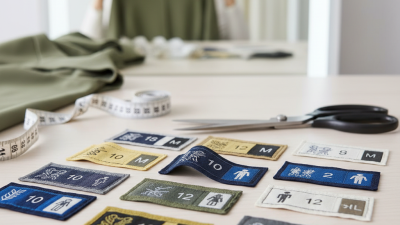
As 2026 buying cycles become more international, Clothing Size Labels are no longer a minor packaging detail. They influence fit decisions, conversion rates, customer trust, and return costs. A buyer in London may read “UK 12,” while a customer in New York expects “US 8.” A shopper in Tokyo may rely on centimeters. The garment may be identical, but the label can create confusion.
The NRF and Happy Returns 2024 Consumer Returns in Retail report estimated that $890 billion in merchandise was returned in the United States during 2024, representing 16.9% of annual retail sales. Apparel remains especially exposed because customers cannot feel fabric stretch or test shoulder width online. The BoF-McKinsey State of Fashion 2025 report also described a slower, more value-conscious fashion market. Better size communication is therefore a practical commercial need, not decoration.
Reliable labels should combine regional sizing, body measurements, garment measurements, and clear unit conversion. ISO 8559-1 provides a professional foundation for defining body measurements, but it does not create one universal clothing-size system. That distinction matters. In factory fit reviews, a neat “M” can still hide a 4-centimeter chest difference. No label system is perfect. Buyers should question charts based on old samples, inconsistent grading, or untested assumptions. The strongest 2026 labels will be readable, multilingual where necessary, digitally supported, and connected to verified measurement data. A simple tape measure still matters.
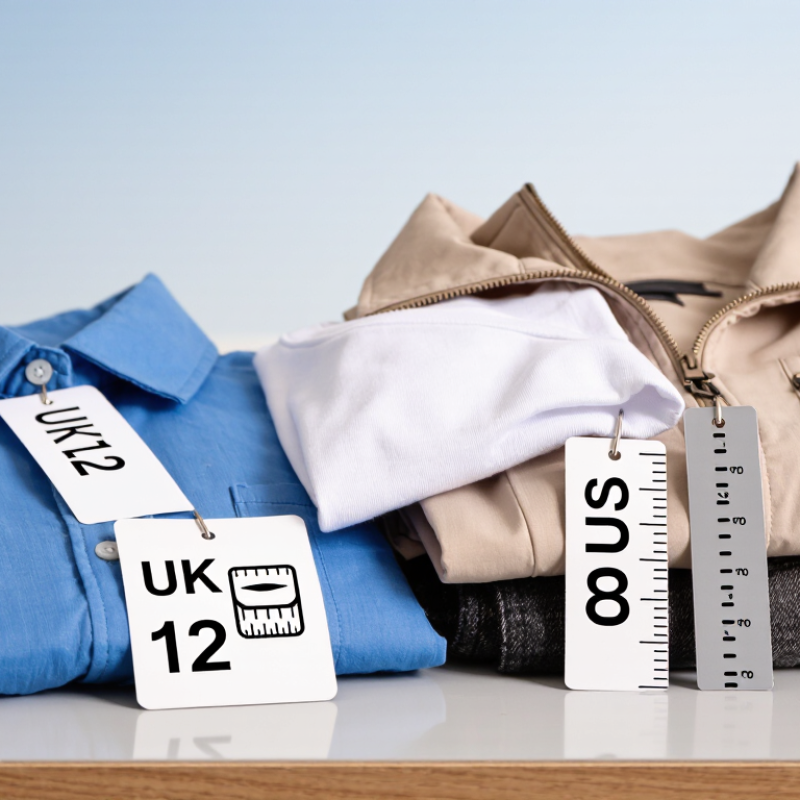
Global clothing size labels rarely follow one universal rule. A medium may fit differently across regions, factories, and garment types. Common systems include letter sizes, numeric regional scales, and centimeter-based measurements. The label alone is not enough. Check chest, waist, hip, inseam, and garment length in the same unit. A tape measure helps. So does a clear conversion chart.
For global buyers, measure the actual garment when possible. Compare a flat shirt against a trusted sample. Record whether the fabric stretches. Note the cut, such as relaxed, slim, or oversized. A technical size chart should show body measurements and acceptable tolerances. In fitting reviews, small errors near the armhole or shoulder can change comfort noticeably. Children’s sizing needs extra care because age labels do not equal body size. Footwear scales should not be mixed with clothing systems.
Digital labels may display several regional sizes, but more information can create confusion. I have seen teams trust a conversion table without checking the original measurements. That choice caused avoidable returns. A better process uses one master measurement chart, then maps each market carefully. Still, no chart is perfect. Bodies vary, and fabric behavior changes after washing. Buyers should test representative samples, document fit comments, and revise labels when evidence disagrees. Small wording changes matter. “Fits small” is useful only when supported by measurements and sample feedback.
| Market or System | Garment Category | Common Label Sequence | Typical Example | Measurement Basis | How the Label Is Read | Approximate Alpha Equivalent | Buyer Guidance |
|---|---|---|---|---|---|---|---|
| International Alpha | Tops, knitwear, outerwear and casual garments | XXS, XS, S, M, L, XL, XXL, 3XL | M | Usually body measurements in cm or inches | M means the middle size in the seller’s size range | Not globally standardized | Always check the seller’s bust, chest, waist and hip chart because the same letter can cover different measurements. |
| United States | Women’s dresses, tops and jackets | 0, 2, 4, 6, 8, 10, 12, 14, 16, 18 | US 8 | Usually bust, waist and hip measurements in inches | Even numbers are common for women’s numeric sizing | Approximately S–M for many size charts | US numerical sizing can differ between garment categories and manufacturers. |
| United Kingdom | Women’s dresses, tops and jackets | 4, 6, 8, 10, 12, 14, 16, 18, 20 | UK 12 | Usually bust, waist and hip measurements in inches or cm | Women’s numbers generally increase by two | Approximately US 8 and EU 40 in many charts | Do not assume a UK number is identical to a US number; the UK number is commonly higher by four. |
| European Union | Women’s dresses, tops and jackets | 32, 34, 36, 38, 40, 42, 44, 46, 48 | EU 40 | Typically body measurements in centimetres | Even-numbered sizing is common | Approximately UK 12 and US 8 in many charts | European sizing is widely used, but regional fitting differences still exist. |
| United States | Men’s shirts, jackets and casual tops | XS, S, M, L, XL, XXL | Men’s L | Chest and neck measurements are commonly shown in inches | Alpha label normally indicates a chest-size range | Often comparable to UK L; EU may use numeric sizing | For fitted shirts, compare both chest and neck measurements rather than relying only on L or XL. |
| United Kingdom | Men’s tailored jackets and suits | 34, 36, 38, 40, 42, 44, 46 | 38R | Chest circumference in inches; jacket length uses S, R or L | 38R means a 38-inch chest with regular length | Approximately EU 48 in many suit charts | The length code refers to garment proportions, not a larger or smaller chest size. |
| European Union | Men’s jackets, suits and trousers | 44, 46, 48, 50, 52, 54, 56 | EU 48 | Chest, waist and seat measurements in centimetres | Numeric size is commonly based on chest proportions | Approximately UK/US 38 in many suit charts | EU trousers may use a separate waist number or a combined waist and inseam code. |
| Japan | Women’s dresses, tops and knitwear | 5, 7, 9, 11, 13, 15, 17 | Japanese 11 | Bust, waist and hip measurements in centimetres | Odd-numbered labels are common for women’s garments | Approximately US 6–8 or EU 38–40, depending on the chart | Japanese garments frequently use a narrower fit; consult actual garment measurements. |
| China | Women’s and men’s apparel | Height/measurement format plus body-type code | 170/88A | Centimetres; height and primary body measurement | 170 indicates height; 88 indicates the main body measurement; A indicates a standard body type | No dependable one-to-one alpha conversion | The measurement sequence is more useful than converting 170/88A directly to S, M or L. |
| South Korea | Women’s fashion apparel | 44, 55, 66, 77, 88, 99 | Korean 66 | Bust, waist and hip measurements in centimetres | Two-digit labels are used instead of international letters | Often listed near M, but conversion varies significantly | Korean sizing can have a slim cut, so flat garment measurements are especially important. |
| United States and United Kingdom | Jeans, trousers and casual pants | Waist × inseam, such as W32/L30 | W32/L30 | Waist and inseam in inches | 32-inch waist and 30-inch inside-leg length | Alpha equivalents are unreliable | Check whether the seller measures the body or the finished garment, and allow for stretch and rise. |
| All Markets | Children’s apparel | Age, height or height range | 110 cm or 5–6 years | Child’s height in centimetres is increasingly used | A 110 label generally targets a child near 110 cm tall | Age-based labels are only approximate | Height, chest and waist measurements are more reliable than age because children grow at different rates. |
| Important sizing note: Clothing size labels are not globally standardized. The same label may represent different body measurements because of regional conventions, garment category, intended fit, fabric stretch, pattern shape and grading practices. For international purchasing, compare the buyer’s body measurements with the seller’s latest size chart and confirm whether measurements refer to the body or the finished garment. | |||||||