Leave Your Message

7 Tips for Choosing the Best Eggshell Sticker

Choosing the right Eggshell Sticker requires more than comparing prices or adhesive strength. An eggshell label must balance tamper evidence, print quality, surface compatibility, and clean application. It should fracture visibly when someone tries to remove it, yet remain stable during shipping and handling. That balance is easy to underestimate.

The wider label market shows why careful selection matters. Grand View Research estimates that the global labels market could reach approximately USD 72.7 billion by 2030, supported by demand for traceability, branding, and product protection. However, this figure covers many label types, not eggshell materials alone. Treating broad market growth as proof of product suitability would be a mistake. Real performance depends on the substrate, adhesive, printer, and environment.

Mike Fairley, a respected label-industry consultant and founder of Label Academy, has often stressed the functional role of labels: “A label is not just decoration; it is a functional part of the pack.” That principle applies strongly to Eggshell Sticker selection. A glossy sticker may look attractive under showroom lights but fail on a textured carton. A strong adhesive may also damage sensitive surfaces unnecessarily. Test it first.

This guide examines seven practical criteria, including material thickness, adhesive behavior, printer compatibility, finish, size, application temperature, and tamper visibility. Consider a small test panel, a refrigerated sample, and a hand-removal trial. Results can be imperfect. That is useful. Careful testing exposes weaknesses before they become customer complaints, rejected shipments, or unclear security signals.
7 Tips for Choosing the Best Eggshell Sticker

What Is an Eggshell Sticker and How Does It Work?

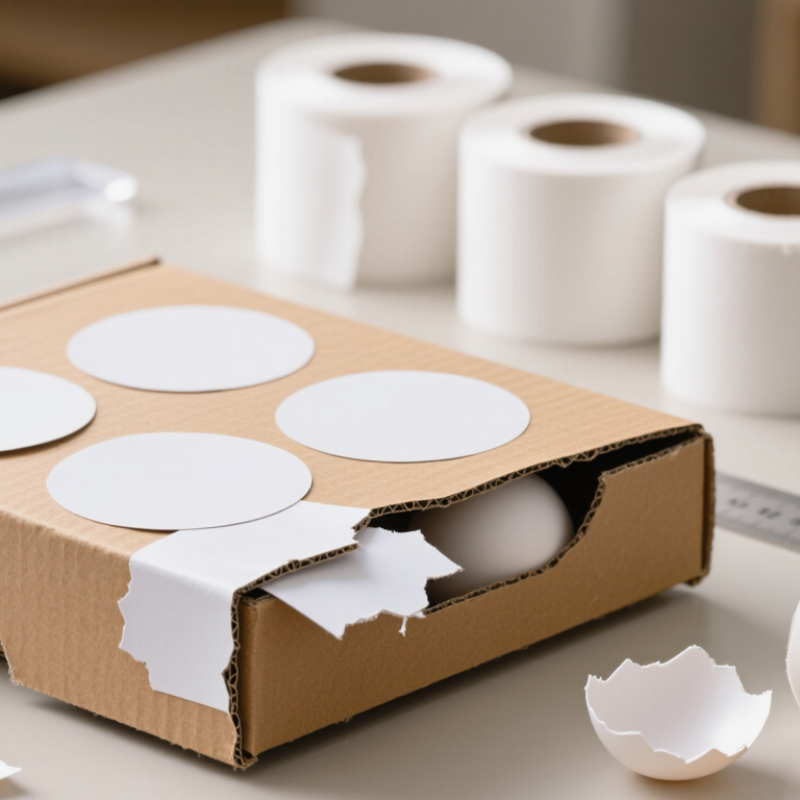
An eggshell sticker is a tamper-evident label made from a thin, fragile vinyl film. Its name comes from its behavior: the material breaks into tiny pieces when someone tries to remove it. A strong adhesive bonds it to a clean surface. The face layer usually cannot be lifted in one piece. That makes reuse difficult. When applied to a laptop, device case, package, or sealed box, it can show interference without electronics. Still, it is not a security system by itself.

Choosing one starts with the surface. Smooth plastic and coated cardboard usually offer reliable contact. Dust, oil, textured paint, and moisture can weaken the bond. I press the label firmly, especially around its edges, then leave it undisturbed. This small step matters.

For outdoor use, check resistance to water, sunlight, and temperature changes. For indoor inventory, a thinner label may be easier to print and apply. A clear serial number or handwritten date can support later inspection.

Test a sample before ordering many labels. Try removing it slowly, quickly, and from different corners. The result should reveal fragments or obvious damage, but performance varies by surface and adhesive age.

I once assumed a clean-looking panel was suitable; its powdery coating caused early lifting. That mistake changed my checklist. Also consider label size, print clarity, and whether the adhesive leaves visible residue. No sticker proves who caused the damage, so record application details and inspect consistently.

Identify the Surface and Purpose of the Sticker

7 Tips for Choosing the Best Eggshell Sticker

Identify the Surface and Purpose of the Sticker

An eggshell sticker is not simply a small label with a rough finish. Its fractured face helps reveal tampering when removal is attempted. Start by examining the application surface under real conditions. Glass is smooth and stable, while powder-coated metal can resist adhesion. Textured plastic and recycled cardboard are more difficult. Dust, oil, moisture, and curved edges can weaken the bond quickly.

Match the sticker to its purpose. For equipment identification, choose a material that resists handling and surface abrasion. For tamper evidence, test whether the label breaks cleanly without leaving readable sections behind. For short-term packaging, excessive adhesion may damage the package. Smithers’ The Future of Labels and Release Liners to 2028 estimates the global labels market will exceed 60 billion dollars by 2028. That growth reflects wider use of specialized labels, but market growth does not guarantee product suitability. Test first.

Press a sample firmly onto the actual surface. Wait 24 to 72 hours. Then try lifting a corner slowly. Check the result after heat, cold, and light moisture exposure. I once judged adhesion after only ten minutes, and the label failed the next morning. That was avoidable. ASTM D3330 peel-testing principles can guide controlled comparisons, although a real-use trial remains essential. Record the surface, temperature, application pressure, and removal behavior before choosing the final eggshell sticker.

Compare Material Quality, Adhesive Strength, and Durability

Choosing an eggshell sticker starts with the material, not the artwork. A smooth, evenly coated surface usually prints sharper and resists light scratches. Check thickness by bending a sample gently; it should flex without cracking or feeling papery. Ask for a technical sheet showing the face stock, coating, and storage conditions. This small step prevents costly guesses.

Adhesive strength depends on the surface, temperature, and pressure. Test samples on painted metal, plastic, glass, and cardboard, because one result proves little. Clean each area, apply firm pressure, and wait 24 hours before judging. A dependable adhesive should resist corner lifting without leaving heavy residue. Peel tests can mislead when surfaces are dusty or textured. Real conditions matter more.

For durability, expose samples to water, rubbing, sunlight, and temperature changes. Record fading, curling, residue, and edge lift after each test. A reliable supplier should explain testing methods, batch consistency, and shelf life. Compare samples under identical conditions. I once underestimated humidity; a sticker held indoors but lifted near a cold window. That mistake changed my checklist. Even a strong adhesive may fail when the material and environment do not match.

7 Tips for Choosing the Best Eggshell Sticker

Compare material quality, adhesive strength, and durability before placing an order.

The practical score uses a 1–5 checklist: 1 means limited suitability and 5 means excellent suitability for the stated selection factor. Material quality considers surface consistency and printability; adhesive strength considers initial tack and peel resistance; durability considers moisture, abrasion, and temperature exposure.

Check Size, Design, Printing Quality, and Customization Options

7 Tips for Choosing the Best Eggshell Sticker

Check size before style. A sticker should follow the egg’s curve without folding over the edge. Measure several eggs, not just one. Natural shells vary slightly. In practical sampling, a 25–30 mm label often suits small logos, dates, or short messages. Leave enough exposed shell for easy handling. Tip 1: Test three sizes on real eggs. A perfect screen mockup can still wrinkle during application.

Design should remain readable under kitchen lighting. Use strong contrast, simple shapes, and lettering that survives a quick glance. Grand View Research valued the global labels market at approximately $49.9 billion in 2022. Its report also forecasts about 5.5% annual growth through 2030. This growth reflects demand for clearer, more flexible labeling. Tip 2: Ask for a physical proof, not only a digital preview. I once preferred a delicate design, but its thin lines disappeared after printing.

Printing quality matters on uneven shells. Inspect edge sharpness, color consistency, and resistance to light moisture. Digital printing can support short runs and variable designs, while conventional printing may suit larger quantities. Smithers identifies shorter runs and personalization as important packaging-printing trends. Tip 3: Request a small production sample. Compare it under daylight and warm indoor light. Tip 4: Confirm customization options, including size, shape, finish, artwork changes, and minimum order quantity. These details are easy to overlook, and that mistake can become expensive.

7 Tips for Choosing the Best Eggshell Sticker - Check Size, Design, Printing Quality, and Customization Options
Tip Selection Dimension What to Check Practical Benchmark Key Question to Ask Priority
1 Sticker Size and Shape Measure the printable area of the eggshell and leave enough space around the design so the sticker does not overlap the curved edges. Choose a size that sits flat on the egg and remains readable without covering excessive shell area. Test the actual sticker on the intended egg size. Will the sticker fit consistently on the smallest and largest eggs in the batch? High
2 Adhesive Performance Review adhesion on clean, dry, and slightly textured eggshells. Check whether the sticker lifts, wrinkles, or leaves residue during handling. The sticker should remain attached during normal packing, transport, and display conditions without visible edge lifting. Has the adhesive been tested on the actual eggshell surface and packaging process? High
3 Design and Readability Evaluate contrast, font size, spacing, logo placement, and the amount of information included on the label. Important information should be readable at a glance, with strong contrast and a clear visual hierarchy between the main message and supporting details. Can customers understand the sticker’s main message quickly from normal viewing distance? High
4 Printing Quality Inspect color consistency, sharpness of small text, alignment, surface coverage, and resistance to smudging or scratching. Fine text should have clean edges, colors should match the approved proof, and the surface should withstand routine handling. Can a physical proof be reviewed before the full production run? High
5 Material and Finish Compare paper, film, matte, gloss, and protective finishes according to the expected exposure to moisture, friction, and temperature changes. Select a finish that supports the required appearance and durability without making the sticker difficult to apply or read. Does the material suit the storage, transportation, and display environment? High
6 Customization Options Confirm available options for size, shape, color, artwork, variable text, numbering, barcodes, and application format. The supplier should provide an artwork proof and clearly state which custom features affect price, setup time, or minimum order quantity. Can the design be adapted for different egg sizes, seasonal campaigns, or product information? Medium
7 Application, Quantity, and Cost Assess manual or automated application, roll or sheet format, order quantity, lead time, packaging, and total cost per sticker. Compare the complete delivered cost rather than unit price alone, and order a small trial quantity before committing to a large run. Will the sticker format support the available application method and production volume? High

Evaluate Application Methods, Removal, and Overall Value

7 Tips for Choosing the Best Eggshell Sticker

Tip 1

Check the application surface before ordering. Clean glass, coated paper, and smooth plastic usually accept eggshell stickers well.

Tip 2

Compare application methods. Hand application suits small batches, while a dispenser improves speed and alignment.

Tip 3

Test the adhesive on a hidden area first. Surface temperature, dust, and moisture can change the result.

I learned this after a label lifted overnight.

Tip 4

Consider removal before purchase. A removable adhesive may peel away cleanly from glass, but it can leave residue on unfinished cardboard.

Tip 5

Review the sticker’s edge strength. Thin edges may curl when handled repeatedly.

Tip 6

Ask for a physical sample, not only a digital preview. The eggshell texture can feel different under bright light.

It may also soften fine text more than expected.

Tip 7

Measure overall value, not just unit price. Include application time, rejected labels, removal effort, and storage needs.

A cheaper sticker can cost more when workers must reposition it. Choose a finish that supports readable printing and dependable handling.

I would also test the sticker after a week of ordinary use. Early results can be misleading.

The perfect option does not always exist. Practical testing usually reveals the better compromise.